


The Knights Templar and Their Influence on the Modern World


More than seven centuries after the medieval Knights Templar were suppressed, their name continues to appear in books, films, churches, fraternal organizations, military traditions, and popular culture. Few medieval institutions have left such a powerful legacy in the modern imagination.
The historical Knights Templar existed for roughly two centuries, beginning in the early 12th century. They were created during the Crusading era as a Christian military religious order, originally associated with protecting pilgrims traveling in the Holy Land. Over time, they became an international organization with estates, churches, fortifications, financial networks, and political influence across Europe and the eastern Mediterranean.
Their direct organization disappeared in the 14th century, but their history, ideals, symbols, and legends continue to influence modern society.
The Templars were unusual because their members combined two medieval roles that normally seemed incompatible: the monk and the warrior.
Templar knights took religious vows while also serving as trained soldiers. Their lives were expected to emphasize obedience, discipline, faith, sacrifice, and service to their mission.
That combination helped create the enduring image of the Christian warrior—someone who believes that strength carries responsibilities and that courage should be guided by faith and moral purpose.
Modern Christian and fraternal organizations that use Templar traditions frequently emphasize principles such as:
Faith. Honor. Duty. Charity. Brotherhood. Service.
Modern groups are not the medieval Knights Templar themselves, but many look to Templar history as an example of commitment, discipline, and service.
The Templars and the Development of International Finance

One of the most interesting aspects of Templar history is their involvement in medieval finance.
Because the Order maintained houses and property across Europe and the Holy Land, it developed systems that allowed money and valuables to be transferred across great distances.
A traveler, pilgrim, nobleman, or crusader could sometimes deposit assets with the Order in one location and receive documentation allowing value to be accessed elsewhere.
This was not modern banking in the way we understand it today, but it demonstrated important principles that later became common in international finance:
Depositing and safeguarding valuables
Transferring funds between regions
Extending credit
Maintaining financial records
Managing estates and investments
Operating financial networks across political borders
The Templars therefore represent an important example of how sophisticated financial administration was developing during medieval Europe.
International Organization Before the Modern Corporation

The Knights Templar also operated something resembling an early international organization.
The Order maintained property and personnel across numerous kingdoms while answering to a centralized leadership.
Templar commanderies and estates generated agricultural income, maintained horses, collected resources, supported travelers, trained members, and supplied military operations overseas.
Their system required communication, accounting, logistics, discipline, and administrative organization across enormous distances.
Modern multinational organizations operate under completely different laws and economic systems, but some organizational challenges remain remarkably familiar:
How do you maintain standards across different regions?
How do you move resources efficiently?
How do local leaders remain accountable to central leadership?
How do you maintain a common identity among members living thousands of miles apart?
The Templars faced medieval versions of those same problems.
Military Organization and Discipline

The Templars also became famous for military discipline.
Medieval warfare could sometimes become chaotic, especially when mounted warriors pursued enemies individually. Military orders attempted to maintain formations and discipline under difficult battlefield conditions.
Templar knights trained to operate together rather than simply seeking individual glory.
Their reputation helped create an enduring principle that continues throughout professional military organizations:
discipline and teamwork are often more important than individual strength.
Modern militaries are vastly different from medieval armies, but concepts such as unit cohesion, command structure, training, duty, sacrifice, and loyalty remain central to military culture.
Charity and Humanitarian Service

Although the Knights Templar were primarily a military religious order, the wider crusading world also produced religious institutions dedicated to caring for pilgrims, the sick, and travelers.
This tradition of combining religious commitment with service influenced later Christian charitable organizations.
Today, many organizations inspired by Christian chivalric traditions focus not on warfare but on charity and humanitarian service.
Modern Templar-inspired organizations may participate in activities such as:
Supporting shelters
Feeding families in need
Helping veterans
Assisting children
Supporting churches
Disaster relief
Community service
International humanitarian projects
In this sense, the modern interpretation of knighthood is often less about carrying a sword and more about accepting a responsibility to serve others.
The Templar Cross and Modern Symbolism

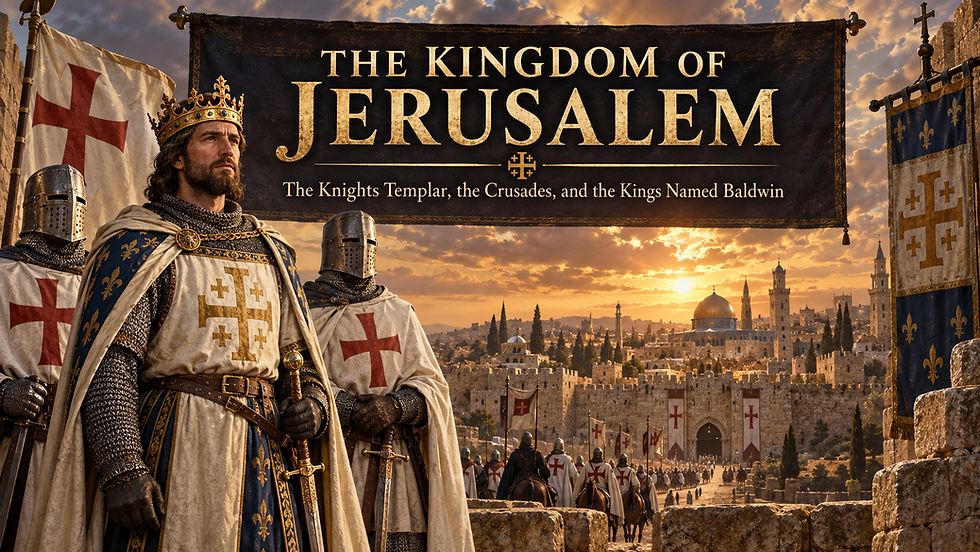
The image of the Templar knight wearing a white mantle marked with a red cross has become one of the most recognizable images associated with the Middle Ages.
Historically, symbols carried tremendous meaning. They represented allegiance, religious devotion, identity, and commitment.
Today, Templar crosses appear on flags, jewelry, artwork, books, patches, challenge coins, organizational insignia, and historical displays.
For modern Christian Templar organizations, the cross may represent something deeper than medieval history.
It can represent:
faith over fear, service over selfishness, duty over convenience, and commitment to Christ.
At the same time, the historical symbols of the Templars should be used responsibly. Medieval history was complicated, and the Crusades involved warfare, politics, religion, cultural conflict, and suffering among Christians, Muslims, Jews, and others. Remembering history accurately requires recognizing both the ideals people claimed and the realities of the age in which they lived.
The Destruction of the Templars and the Importance of Due Process

The dramatic downfall of the Knights Templar has also contributed to their modern fascination.
In 1307, King Philip IV of France ordered the arrest of many Templars in his kingdom. Serious accusations were made against the Order, interrogations followed, and some confessions were obtained under coercive conditions.
After years of political and religious controversy, Pope Clement V formally dissolved the Order in 1312.
The last Grand Master, Jacques de Molay, was executed in Paris in 1314.
These events have inspired centuries of debate about political power, financial interests, accusations, institutional conflict, and justice.
For modern readers, the fall of the Templars can serve as a reminder that governments and institutions possess enormous power and that accusations must be examined carefully and fairly.
Legends, Mysteries, and Popular Culture

The historical Templars are fascinating enough, but the legends surrounding them have become even larger.
Over the centuries, stories have connected the Templars with hidden treasures, secret societies, sacred relics, mysterious documents, underground survival, and numerous conspiracy theories.
Many of these claims cannot be supported by reliable historical evidence.
Nevertheless, they have helped make the Knights Templar permanent figures in popular culture.
Templars appear throughout novels, movies, television programs, documentaries, video games, artwork, and historical fiction.
The challenge is separating history from legend.
The real Knights Templar already have an extraordinary story. Their genuine history does not need to be exaggerated to remain fascinating.
Modern Templar Organizations

Various organizations throughout the world today use Templar names, crosses, titles, traditions, or principles.
These modern organizations should generally be understood as revival, commemorative, charitable, Christian, or fraternal organizations inspired by Templar history, rather than as an uninterrupted continuation of the medieval Order.
Their strongest connection to the historical Templars is therefore not necessarily a documented institutional bloodline.
It is often a connection through ideals.
Faith.
Service.
Charity.
Discipline.
Brotherhood and sisterhood.
Personal responsibility.
Defense of Christian principles.
Helping those who cannot help themselves.
Those principles can still have meaning in the 21st century.
What Does It Mean to Be a Templar Today?

Modern society does not need medieval armies marching across Europe or the Holy Land.
But society will always need people willing to serve.
The battlefield has changed.
For a modern Christian inspired by Templar ideals, the struggle may involve helping a homeless family, supporting a veteran, feeding someone who is hungry, protecting the vulnerable, strengthening a church, mentoring a young person, or having the courage to defend one's convictions peacefully.
A modern knight does not prove himself simply by wearing a mantle, displaying a cross, or carrying a title.
The greater test is how he or she lives.
Does the person serve?
Does the person keep their word?
Does the person show compassion?
Does the person demonstrate discipline?
Does the person place faith above ego?
Does the person help others without demanding recognition?
Those questions may represent one of the most meaningful connections between medieval chivalry and modern life.
The Templar Legacy

The medieval Knights Templar disappeared more than 700 years ago, yet their story remains alive.
Their military discipline influenced how generations imagined the ideal warrior.
Their financial networks demonstrate the sophistication of medieval international commerce.
Their organization showed how a powerful institution could operate across national borders.
Their dramatic downfall continues to provoke questions about politics, justice, and institutional power.
Their symbols remain recognized throughout the world.
And their ideals continue to inspire people who believe that faith should produce action.
The greatest lesson of the Knights Templar may therefore not be found in castles, swords, battles, or legends.
It may be found in a much simpler idea:
A knight's strength should be measured by whom he serves rather than by the power he possesses.
The medieval world is gone.
The opportunity to live with faith, honor, duty, courage, charity, and service remains.
Non Nobis, Domine, Non Nobis, Sed Nomini Tuo Da Gloriam.
"Not unto us, O Lord, not unto us, but unto Thy name give glory." — Psalm 115:1


Comments